This is the last part in my series on understanding scientific text. In this part, as promised, I am going to talk about the difficulties novices have with scientific texts; what they or their teachers can do about it; and the problems with introductory textbooks.
Articles
Common everyday memory strategies
The most frequently used everyday memory strategies are:
Visual Language, a term introduced by Robert Horn, refers to "language based on tight integration of words and visual elements". The visual elements include shapes, as well as images (e.g., icons, clip art).
What does this have to do with memory? Well, partly of course, because the appropriate use of images usually makes information more memorable, but visual language has considerably more to offer than that. To appreciate what it is, Horn has examples at http://web.stanford.edu/~rhorn/
Does emotion help us remember? That's not an easy question to answer, which is unsurprising when you consider the complexities of emotion.
First of all, there are two, quite different, elements to this question. The first concerns the emotional content of the information you want to remember. The second concerns the effect of your emotional state on your learning and remembering.
The effect of emotional content
It does seem clear that, as a general rule, we remember emotionally charged events better than boring ones.
Prevalence of dementia
Dementia is estimated1 to afflict over 35.5 million people worldwide -- this includes nearly 10 million people in Europe, nearly 4.4 million in North America, nearly 7 million in South and Southeast Asia, about 5.5 million in China and East Asia and about 3 million in Latin America.
Most people believe that an adult learner can't hope to replicate the fluency of someone who learned another language in childhood. And certainly there is research to support this. However, people tend to confuse these findings - that the age of acquisition affects your representation of grammar - with the idea that children can learn words vastly quicker than adults. This is not true. Adults have a number of advantages over children:
Montessori education
Maria Montessori (1870-1952) was an Italian physician. After working with retarded children in a psychiatric clinic attached to the University of Rome, she applied the ideas she had developed to children in a slum district in Rome. This was the first Casa dei Bambini ("children's house"). It opened in 1907. Two years later she set out her methods and principles in a book, which was translated as The Montessori Method in 1912.
A number of countries have national curricula: France, Hungary, Ireland, Italy, Japan, Korea, the Netherlands, New Zealand, Norway, Portugal, Singapore, Spain, the United Kingdom. Most States in the U.S. follow common guidelines for a core curriculum, although there is no national curriculum as such.
Find out about the pegword mnemonic
Here are pegwords I've thought up in the Spanish language.
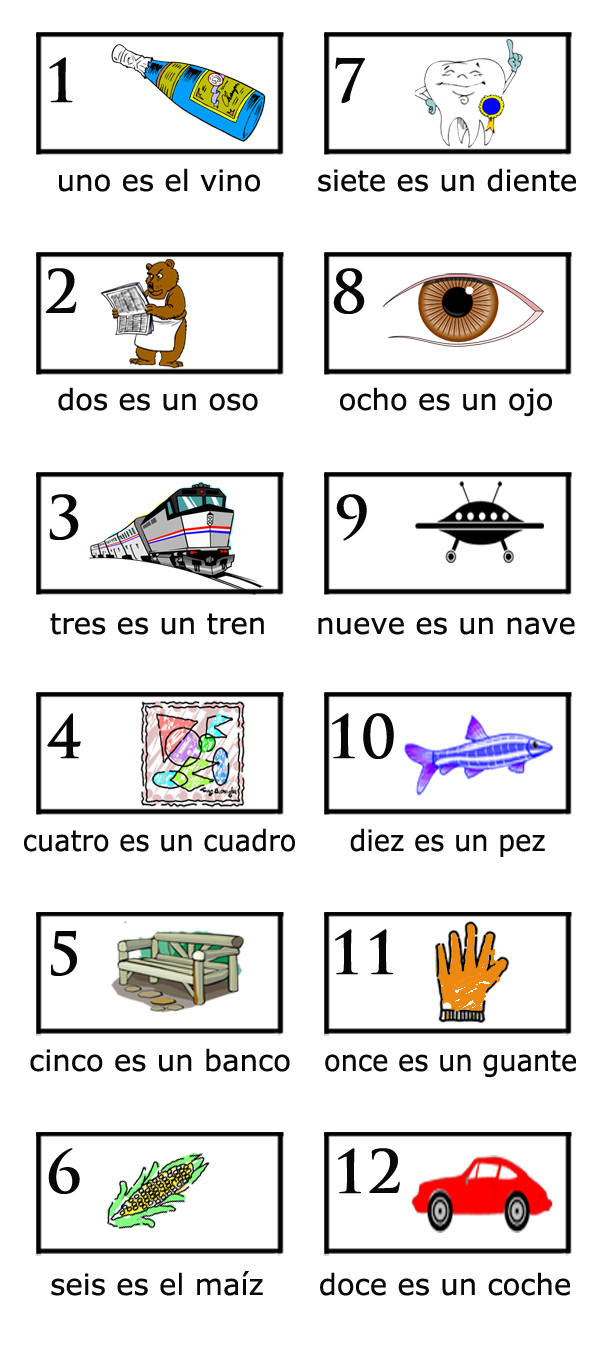
As with the original example, let's try it out with our cranial nerves.
En español, los nervios craneales son:
I was listening to a podcast the other day. Two psychologists (Andrew Wilson and Sabrina Galonka) were being interviewed about embodied cognition, a topic I find particularly interesting.