Find out about the pegword mnemonic
Here are pegwords I've thought up in the Spanish language.
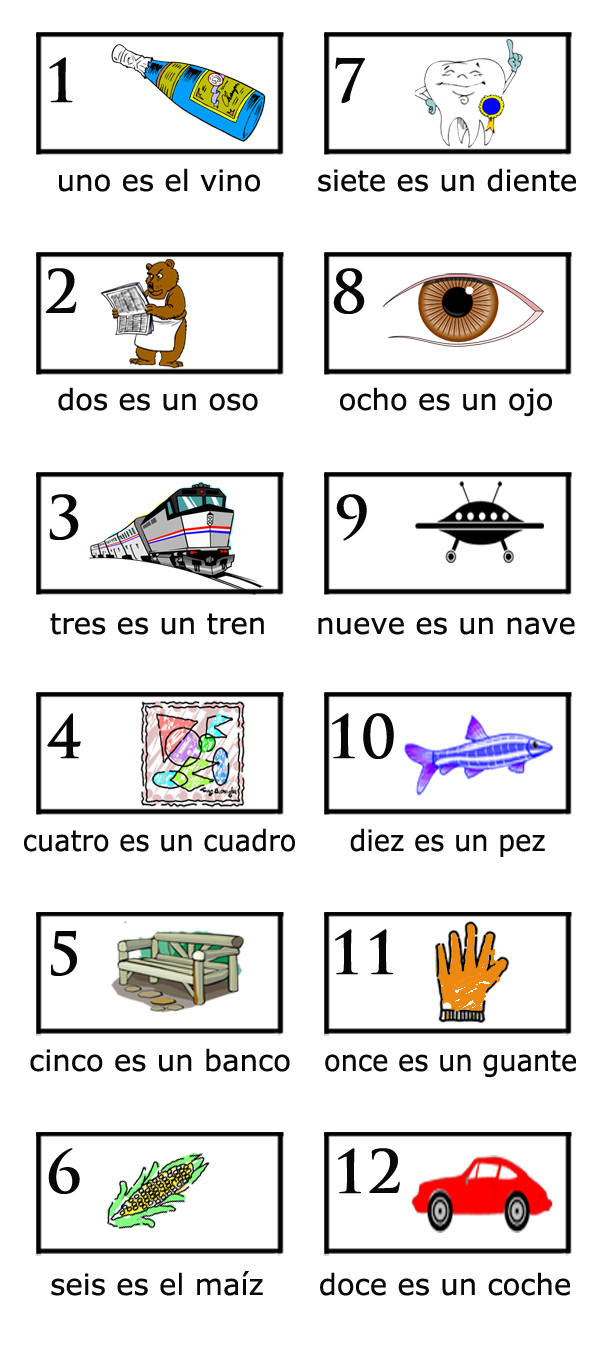
As with the original example, let's try it out with our cranial nerves.
En español, los nervios craneales son:
Find out about the pegword mnemonic
Here are pegwords I've thought up in the Spanish language.
As with the original example, let's try it out with our cranial nerves.
En español, los nervios craneales son:
Graphic summaries are summaries that reorganize the text. Two examples of graphic summaries are outlines and graphic organizers.
In an outline, topics are listed with their subtopics in a linear format, like this:
Branches of Government (U.S.A.) |
|||
|
I. |
Executive Branch |
|
|
|
| |||
Frontotemporal dementia is a disorder of the frontal lobes and includes what was known as primary progressive aphasia. Although it occurs far less often than Alzheimer's disease, among dementia sufferers younger than 65 it is estimated to occur at about the same rate. In other words, frontotemporal dementia is, unlike the most common dementias, not a disorder of age. Most sufferers become symptomatic in their 50s and 60s.
As I said in my discussion of different scripts, the Hellenic languages use the Greek alphabet. Here it is. I’m afraid the table is a little complicated, because (a) each letter has a name, which it’s useful to know, and (b) there are some differences in pronunciation between Ancient Greek (which is still a language that people want to learn today), and Modern Greek.
A Scientific American article talks about a finding that refines a widely-reported association between self-regulation and academic achievement. This association relates to the famous ‘marshmallow test’, in which young children were left alone with a marshmallow, having been told that if they could hold off eating it until the researcher returns, they would get two marshmallows.
When we are presented with new information, we try and connect it to information we already hold. This is automatic. Sometimes the information fits in easily; other times the fit is more difficult — perhaps because some of our old information is wrong, or perhaps because we lack some of the knowledge we need to fit them together.
Maria Montessori (1870-1952) was an Italian physician. After working with retarded children in a psychiatric clinic attached to the University of Rome, she applied the ideas she had developed to children in a slum district in Rome. This was the first Casa dei Bambini ("children's house"). It opened in 1907. Two years later she set out her methods and principles in a book, which was translated as The Montessori Method in 1912.
Consider our facts about blood:
We could, as is often advised, simply turn these into why questions. And we can answer these on the basis of the connections we’ve already made:
Because they need to accommodate changes in pressure
Because they need to accommodate high pressure
In the following case study, I explore in depth the issue of learning the geological time scale — names, dates, and defining events. The emphasis is on developing mnemonics, of course, but an important part of the discussion concerns when and when not to use mnemonics, and how to decide.
Phanerozoic Eon 542 mya—present
Cenozoic Era 65 mya—present
This post is the fourth and last part in a four-part series on how education delivery is changing, and the set of literacies required in today’s world. Part 1 looked at textbooks; Part 2 at direct instruction/lecturing; Part 3 at computer learning.. This post looks at learning models and types of literacy.
Literacy. What does it mean?