Articles
In a recent news report, I talked about how walking through doorways creates event boundaries, requiring us to update our awareness of current events and making information about the previous location less available. I commented that we should be aware of the consequences of event boundaries for our memory, and how these contextual factors are important elements of our filing system. I want to talk a bit more about that.
Elaborative interrogation is a strategy to help you remember meaningful information. The idea behind the strategy is that relevant prior knowledge is not always readily activated when you are trying to learn new information, and sometimes help is needed to make the right connections. The strategy requires you to go beyond the information given to you and to construct reasons for the relationships between bits of information.
To choose a strategy, you must assess the situation. In this case, this may mean an evaluation of a written text. Let's look at how you might evaluate text.
We can classify text at one of three different levels, according to its structure and density1:
Let's look a little deeper into the value of mnemonics for knowledge acquisition. By “knowledge acquisition”, I mean the sort of information you learn from textbooks — information that is not personal, that you need for the long-term.
In this context, I believe the chief value of mnemonic strategies is to help you recall information that needs to be remembered in a particular order. Thus we use mnemonics to help us remember the order of the planets, the order of musical notes on the stave, the order of the colors in a rainbow.
Find out about the pegword mnemonic
Here are pegwords I've thought up in the French language.
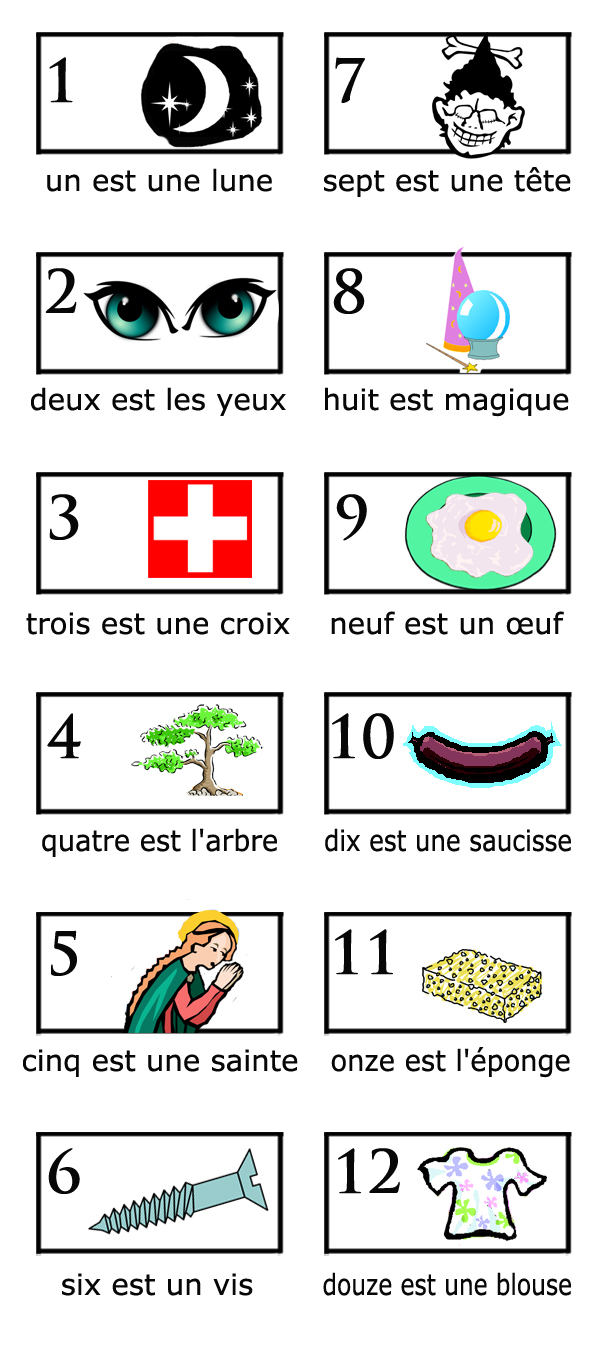
As with the original example, let's try it out with our cranial nerves.
En francais, les nerfs crâniens son:
As I said in my discussion of different scripts, the Hellenic languages use the Greek alphabet. Here it is. I’m afraid the table is a little complicated, because (a) each letter has a name, which it’s useful to know, and (b) there are some differences in pronunciation between Ancient Greek (which is still a language that people want to learn today), and Modern Greek.
Many people, particularly as they get older, have concerns about short-term memory problems: going to another room to do something and then forgetting why you’re there; deciding to do something, becoming distracted by another task, and then forgetting the original intention; uncertainty about whether you have just performed a routine task; forgetting things you’ve said or done seconds after having said or done them; thinking of something you want to say during a conversation, then forgetting what it was by the time it’s your turn to speak, and so on.
There are two well-established strategies for remembering people’s names. The simplest basically involves paying attention. Most of the time our memory for someone’s name fails because we never created an effective memory code for it.
An easy strategy for improving your memory for names
We can dramatically improve our memory for names simply by: