At the same time as a group of French parents and teachers have called for a two-week boycott of homework (despite the fact that homework is officially banned in French primary schools), and just after the British government scrapped homework guidelines, a large long-running British study came out in support of homework.
Articles
I recently reported on a finding that older adults whose life-space narrowed to their immediate home were significantly more likely to have a faster rate of global cognitive decline or develop mild cognitive impairment or Alzheimer’s.
A very common situation today, which is probably responsible for a great deal of modern anxiety about failing memory, is that where we're required to “multitask”, that trendy modern word for trying to do more than one thing at a time. It is a situation for which both the normal consequences of aging and low working memory capacity has serious implications.
Find out about the pegword mnemonic
Here are pegwords I've thought up in the Spanish language.
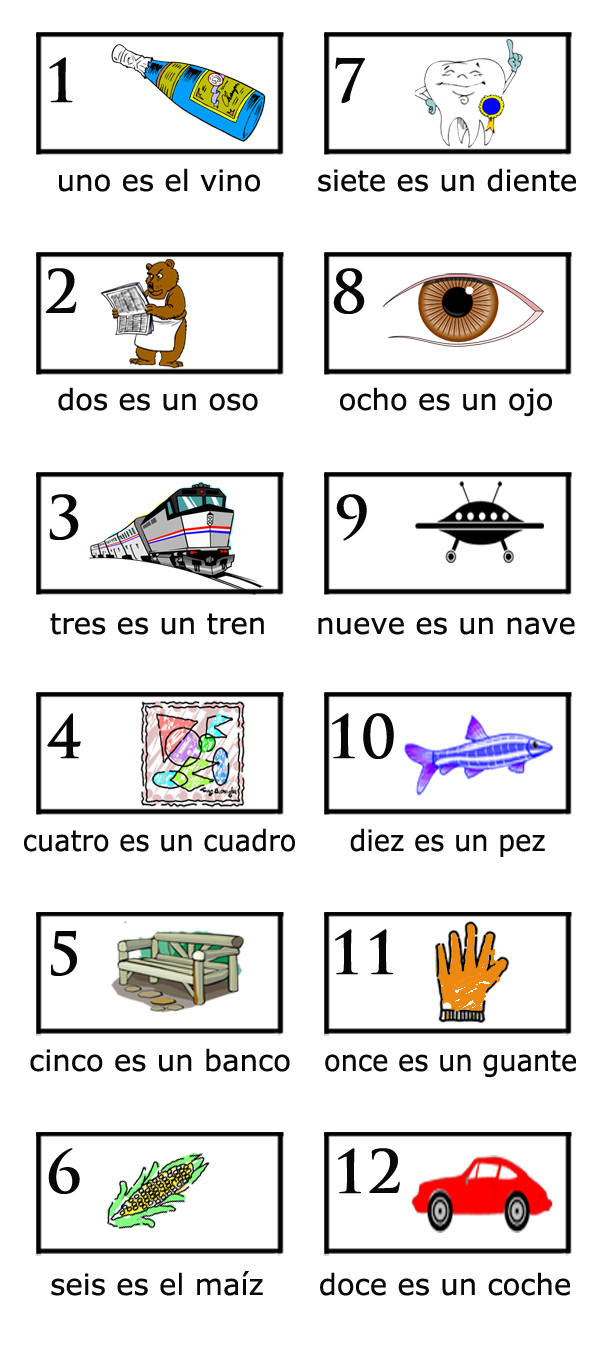
As with the original example, let's try it out with our cranial nerves.
En español, los nervios craneales son:
Back in 2010, I read a charming article in the New York Times about a bunch of neuroscientists bravely disentangling themselves from their technology (email, cellphones, laptops, …) and going into the wilderness (rafting down the San Juan River) in order to get a better understanding of how heavy use of digital technology might change the way we think, and whether we can reverse the problem by immersing ourselves in nature.
When considering what will be the most effective strategies for you, don't forget the basic principles of memory:
(1) Repetition repetition repetition
The trick is to find a way of repeating that is interesting to you. This is partly governed by level of difficulty (too easy is boring; too difficult is discouraging). The point is to find an activity (more than one, in fact), which enable you to hold on to your motivation through sufficient repetitions to drive them into your head. Bear in mind, too, the importance of:
(2) Changing context
This is the last part in my series on understanding scientific text. In this part, as promised, I am going to talk about the difficulties novices have with scientific texts; what they or their teachers can do about it; and the problems with introductory textbooks.
Why do we need sleep?
A lot of theories have been thrown up over the years as to what we need sleep for (to keep us wandering out of our caves and being eaten by sabertooth tigers, is one of the more entertaining possibilities), but noone has yet been able to point to a specific function of the sleep state that would explain why we have it and why we need so much of it.
A perennial topic in the arena of memory improvement is the question of “food for the brain”, and in particular, whether there are dietary supplements that can improve your mental abilities. While my own emphasis is improvement through development and practice of skills, I don’t dismiss the possibility of improvement through more physical means. I myself am a great fan of the “you are what you eat” principle. This is mainly because I suffer from multiple food sensitivities, so the consequences of food are very much a reality for me.
Remembering a skill is entirely different from remembering other kinds of knowledge. It’s the difference between knowing how and knowing that.