The Proto-Indo-European language (PIE) is the ultimate ancestor of many European and Indian languages. The word "proto" indicates it was spoken thousands of years in the past and we have no direct record of it. What we do have is the clear evidence in its descendant languages, from the consistent patterns in the way their words vary, that there was such an ancestor. Following these patterns, scholars have deduced a quite extensive vocabulary — but they are still reconstructed, not ‘real’ words. We can never know exactly how these words were pronounced, or precisely how they were used.
Articles
How many words do you need to learn?
An analysis of English vocabulary* has found that the first 1000 words account for 84.3% of the words used in conversation, 82.3% of the words encountered in fiction, 75.6% of the words in newspapers, and 73.5% of the words in academic texts. The second 1000 accounts for about another 5% (specifically, 6% of conversation, 5.1% of fiction, 4.7% of newspapers, 4.6% of academic texts).
The limitations of working memory have implications for all of us. The challenges that come from having a low working memory capacity are not only relevant for particular individuals, but also for almost all of us at some points of our lives. Because working memory capacity has a natural cycle — in childhood it grows with age; in old age it begins to shrink. So the problems that come with a low working memory capacity, and strategies for dealing with it, are ones that all of us need to be aware of.
What is it?
Frontotemporal dementia is a disorder of the frontal lobes and includes what was known as primary progressive aphasia. Although it occurs far less often than Alzheimer's disease, among dementia sufferers younger than 65 it is estimated to occur at about the same rate. In other words, frontotemporal dementia is, unlike the most common dementias, not a disorder of age. Most sufferers become symptomatic in their 50s and 60s.
Learning a new language is made considerably more difficult if that language is written in an unfamiliar script. For some, indeed, that proves too massive a hurdle, and they give up the attempt.
Except in the cases of stroke or traumatic brain injury, loss of cognitive function is not something that happens all at once. Cognitive impairment that comes with age may be thought of as belonging on a continuum, with one end being no cognitive impairment and the other end being dementia, of which Alzheimer's is the most common type.
The story method (sometimes called the sentence mnemonic) is the most easily learned list-mnemonic strategy, although it is not as widely known as the other simple methods we’ve talked about so far.
As its name suggests, the story method involves linking words to be learned in a story. While this is most obviously useful for learning actual lists, it can also be used for remembering the main points of a passage. In such a case, you need to reduce each point to a single word, which hopefully has the power to recall the whole point.
Find out about the pegword mnemonic
Here are pegwords I've thought up in the Italian language.
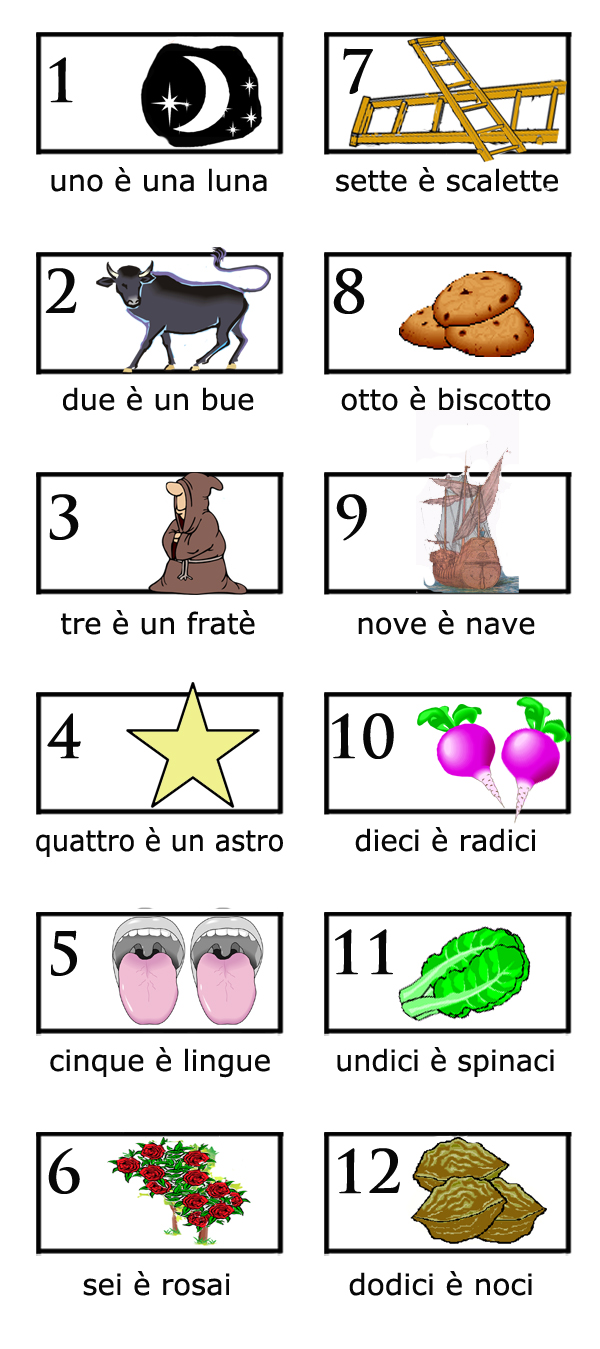
As with the original example, let's try it out with our cranial nerves.
In italiano, sono i nervi cranici:
Elaborative interrogation is a strategy to help you remember meaningful information. The idea behind the strategy is that relevant prior knowledge is not always readily activated when you are trying to learn new information, and sometimes help is needed to make the right connections. The strategy requires you to go beyond the information given to you and to construct reasons for the relationships between bits of information.