Articles
In the education world, fixed mind-set is usually contrasted with growth mind-set. In this context, fixed mind-set refers to students holding the idea that their cognitive abilities, including their intelligence, are set at birth, and they just have to accept their limitations. With a growth mind-set, however, the student recognizes that, although it might be difficult, they can grow their abilities.
A growth mind-set has been associated with a much better approach to learning and improved academic achievement, but new research suggests that this difference has been over-stated.
What do we mean by word-finding problems?
Here are some examples:
- increasing use of circumlocutions rather than specific terms (e.g., "I wonder where the thing that goes here is")
- use of empty phrases, indefinite terms, and pronouns without antecedents (i.e., referring to something or someone as "it" or "him / her" without first identifying them by name)
- increased frequency of pauses
These problems are all characteristic of Alzheimer's, but also, to a much lesser extent, of normal aging.
Here are some notes on the water cycle:
Hydrological (water) cycle
Precipitation & flow: “whether they are typhoons or Scotch mists, mountain torrents or field ditches or city sewers, they are simply water sinking back to base level, the sea.”
Evaporation = the act of passively presenting water to the atmosphere to be soaked up + vaporized by the sun’s energy.
Transpiration= evaporation thru plants
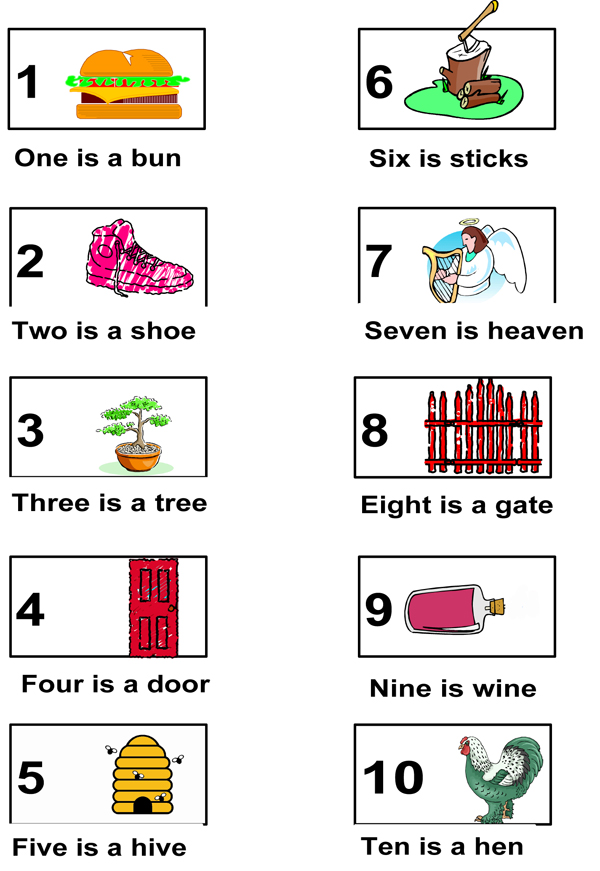
If you have a numbered list to memorize, the best mnemonic strategy is the pegword mnemonic. This mnemonic uses numbers which have been transformed into visual images. Here's the standard 1-10 set.
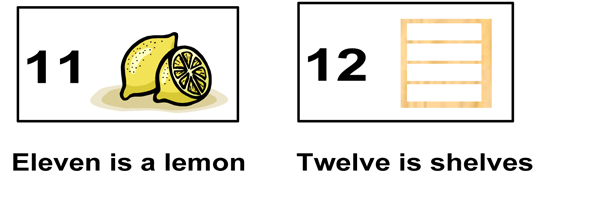
I add two more:
A fascinating article recently appeared in the Guardian, about a woman who found a way to overcome a very particular type of learning disability and has apparently helped a great many children since.
Introduction
In 1997, the U.S. Congress asked the Director of the National Institute of Child Health and Human Development (NICHD) at the National Institutes of Health, in consultation with the Secretary of Education, to convene a national panel to assess the effectiveness of different approaches used to teach children to read. For over two years, the National Reading Panel reviewed research-based knowledge on reading instruction and held open panel meetings in Washington, DC, and regional meetings across the United States.
Knowing a number of effective strategies for reading and note-taking, practicing and memorizing, is vital, but it's not the whole story. There is also a category of strategies we might term 'support' strategies. These include strategies aimed at setting goals, managing time and effort, and monitoring your performance and progress. In study, these come under the concept of self-regulation, which is related to the more general concept of metamemory.
Consider our facts about blood:
- arteries are thick and elastic and carry blood that is rich in oxygen from the heart.
- veins are thinner, less elastic, and carry blood rich in carbon dioxide back to the heart.
We could, as is often advised, simply turn these into why questions. And we can answer these on the basis of the connections we’ve already made:
Why are arteries elastic?
Because they need to accommodate changes in pressure
Why are arteries thick?
Because they need to accommodate high pressure