Find out about the pegword mnemonic
Here are pegwords I've thought up in the French language.
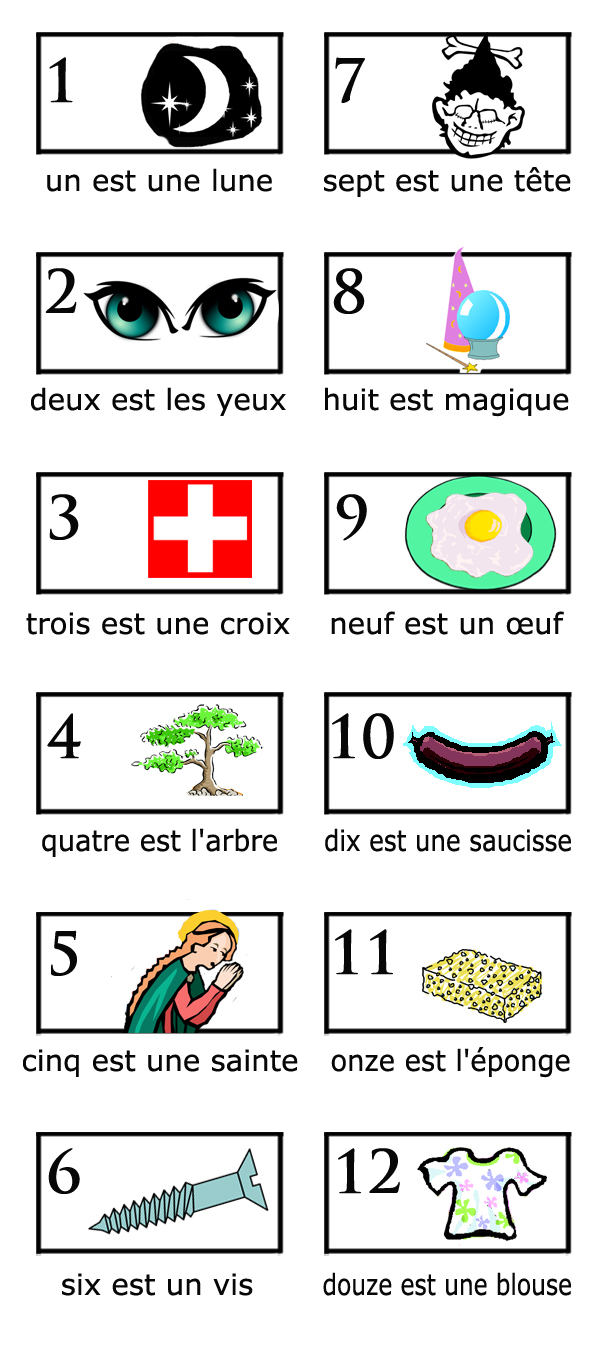
As with the original example, let's try it out with our cranial nerves.
En francais, les nerfs crâniens son:
Find out about the pegword mnemonic
Here are pegwords I've thought up in the French language.
As with the original example, let's try it out with our cranial nerves.
En francais, les nerfs crâniens son:
Some comments on the commonalities between the Suzuki approach to learning music and the Montessori approach to education.
My sons have both been in Montessori since they were three (they are now 8 and nearly 11, respectively). My elder son started learning the violin from a Suzuki teacher when he was around five, and now learns the piano (again, from a Suzuki teacher). My younger son has been learning the violin for the last two years. Over the years I have been somewhat intrigued by the number of parents who, like me, are both Montessori and Suzuki parents.
The other day I was sitting in the sunshine in my living room going through some journal articles I'd photocopied. I realized I needed to staple the pages together and went down to my study to get the stapler. Approaching my desk, I decided to check my email while I was there. And then, I decided to check my library account online to see whether a book I had requested had turned up. When I'd done that, I went back upstairs to my papers. Where I realized, of course, that I'd forgotten the stapler.
"Photographic" or eidetic memory is said to occur in some 8% of children, but almost all of these grow out of it. The phenomenon is extremely rare in adults, and indeed the very existence of photographic memory is still somewhat contentious. However, it may be that particular brain abnormalities can lead to ways of processing information that are dramatically different from the normal (see the case of Kim Peek).
Reading is a deceptive skill, for it is not a single process, but a number of processes. Thus, while you might be a fluent reader, in that you can swiftly and easily decode the letter-markings, and quickly access the meaning of the words, that doesn't mean you're a skilled reader of informational texts.
Many people, particularly as they get older, have concerns about short-term memory problems: going to another room to do something and then forgetting why you’re there; deciding to do something, becoming distracted by another task, and then forgetting the original intention; uncertainty about whether you have just performed a routine task; forgetting things you’ve said or done seconds after having said or done them; thinking of something you want to say during a conversation, then forgetting what it was by the time it’s your turn to speak, and so on.
A study1 of nearly 2000 older adults has found that eating a Mediterranean diet was associated with less risk of developing mild cognitive impairment or of transitioning from MCI to Alzheimer's disease. The third with the highest scores for Mediterranean diet adherence had a 28% lower risk of developing MCI compared to the third with the lowest scores, and of those who already had MCI, those with the highest scores for Mediterranean diet adherence had a 48% less chance of developing Alzheimer’s.
I recently reported on a finding that memories are stronger when the pattern of brain activity is more closely matched on each repetition, a finding that might appear to challenge the long-standing belief that it’s better to learn in different contexts. Because these two theories are very important for effective learning and remembering, I want to talk more about this question of encoding variability, and how both theories can be true.
As we all know, we are living in a time of great changes in education and (in its broadest sense) information technology. In order to swim in these new seas, we and our children need to master new forms of literacy. In this and the next three posts, I want to explore some of the concepts, applications, and experiments that bear on this.
The limitations of working memory have implications for all of us. The challenges that come from having a low working memory capacity are not only relevant for particular individuals, but also for almost all of us at some points of our lives. Because working memory capacity has a natural cycle — in childhood it grows with age; in old age it begins to shrink. So the problems that come with a low working memory capacity, and strategies for dealing with it, are ones that all of us need to be aware of.